Root canal treatment under a microscope.Preserve your tooth whenever possible.

When to see an endodontist.
A symptom is a reason to find the cause.
A single symptom cannot tell you whether you need root canal treatment. Your dentist will examine the tooth, perform the necessary tests and explain your options.
Pain when biting
Especially if it persists, worsens or affects a previously treated tooth.
A lingering reaction to heat or cold
Discomfort continues after the stimulus has gone.
Swelling, inflammation or a draining sinus
An examination is needed to identify the cause and assess the tissues around the tooth.
Symptoms return after treatment
We assess the cause of recurring symptoms and whether retreatment is possible.
Changes on an X-ray
A consultation may be needed even without significant pain.
An extraction has been recommended
We can assess whether there is a clinically sound option for preserving the tooth.
Before a complex restoration
Root canals are assessed when indicated. A crown alone does not mean that root canal treatment is needed.
Swipe to explore other situations →
What happens during root canal treatment.
Examination and X-rays
We assess the tooth and its prognosis. Cone beam CT is prescribed if the available information is insufficient.
Reaching the canals
Your dentist creates access while preserving as much healthy tooth structure as the clinical situation allows.
Cleaning the root canal system
Mechanical preparation and disinfecting solutions aim to eliminate infection.
Filling the canals
After cleaning, the canals are filled and sealed, and the result is checked.
Restoring function
The restoration is selected according to the amount of remaining tooth structure and the forces on the tooth.
The tooth needs a restoration.
Depending on your needs, this may be a filling, inlay, onlay or crown. Root canal treatment and the restorative stage are planned together.
Restoration options →We discuss an alternative.
When a tooth cannot be preserved with a reasonable prognosis, the team explains the alternatives, including extraction and replacement.
Dental implants →The ZEISS microscope:seeing complex anatomy.
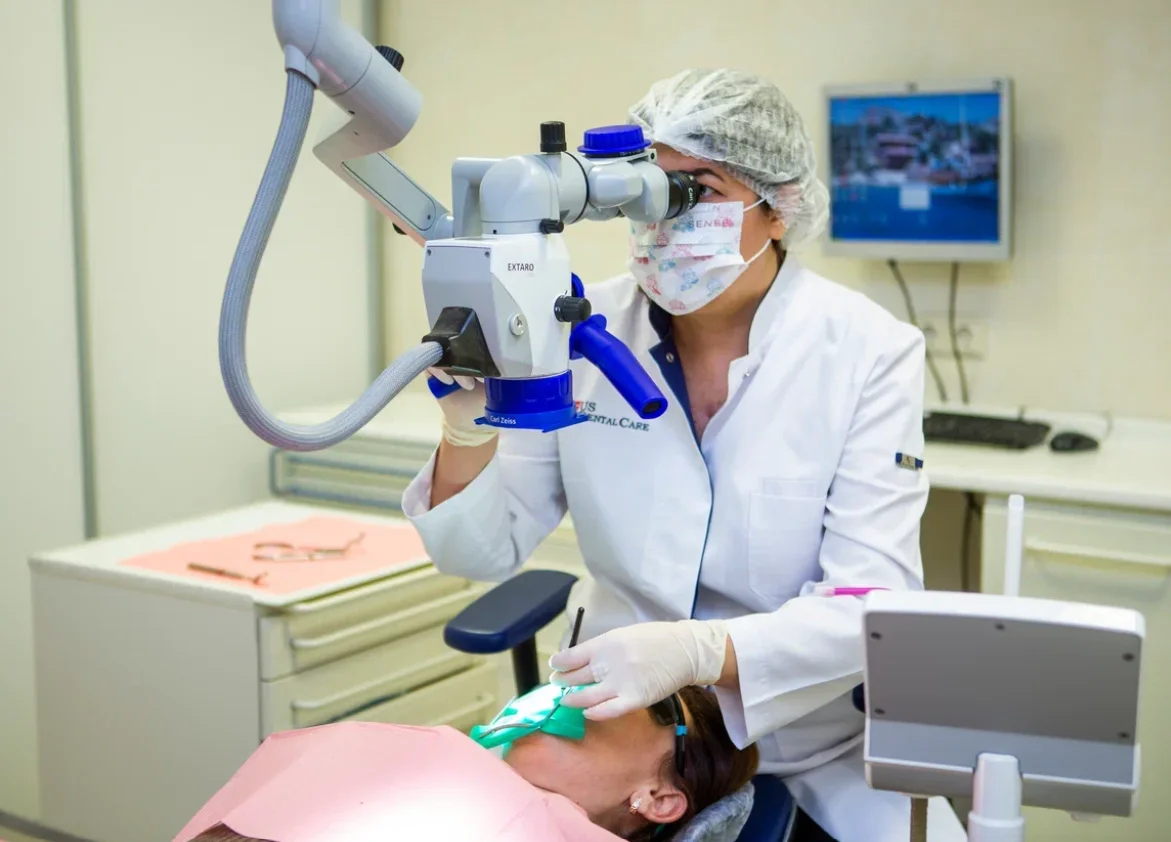
Especially useful in complex anatomy and retreatment.
Supporting the dentist's treatment decisions.
Magnification is complemented by working length measurement, cleaning, filling and checks. Equipment supports diagnosis and clinical judgment.
Ultrasonic systems
For working with existing filling material, posts and difficult areas when indicated.
Endodontic motors
For controlled mechanical preparation tailored to canal anatomy.
Apex locators
For measuring working length and monitoring preparation depth.
Warm gutta-percha
For filling the root canal system after cleaning and preparation.
Initial root canal treatment and retreatment.
The canals have not been treated before.
The canals have been treated before.
Ksenia Matsepuro, endodontist.
Care for complex root canal systems.
Root canal treatment fees.
Root canal treatment: anterior tooth
A guide from our current price list. Fees for other teeth and retreatment are calculated individually.Start with an endodontic examination.

Moscow, Olympiyskiy prospect 16 bld.5, Olimpic Hall Business Center
Contact the clinic
Choose how to contact us.